
A Topology-Aware Spatiotemporal Handover Framework for Continuous Multi-UAV Tracking
Authors: Jianlin Ye, Christos Kyrkou, Panayiotis Kolios
Venue: 2026 International Conference on Unmanned Aircraft Systems (ICUAS)
Location: Corfu, Greece
Pages:
Publisher: IEEE
DOI:
Abstract
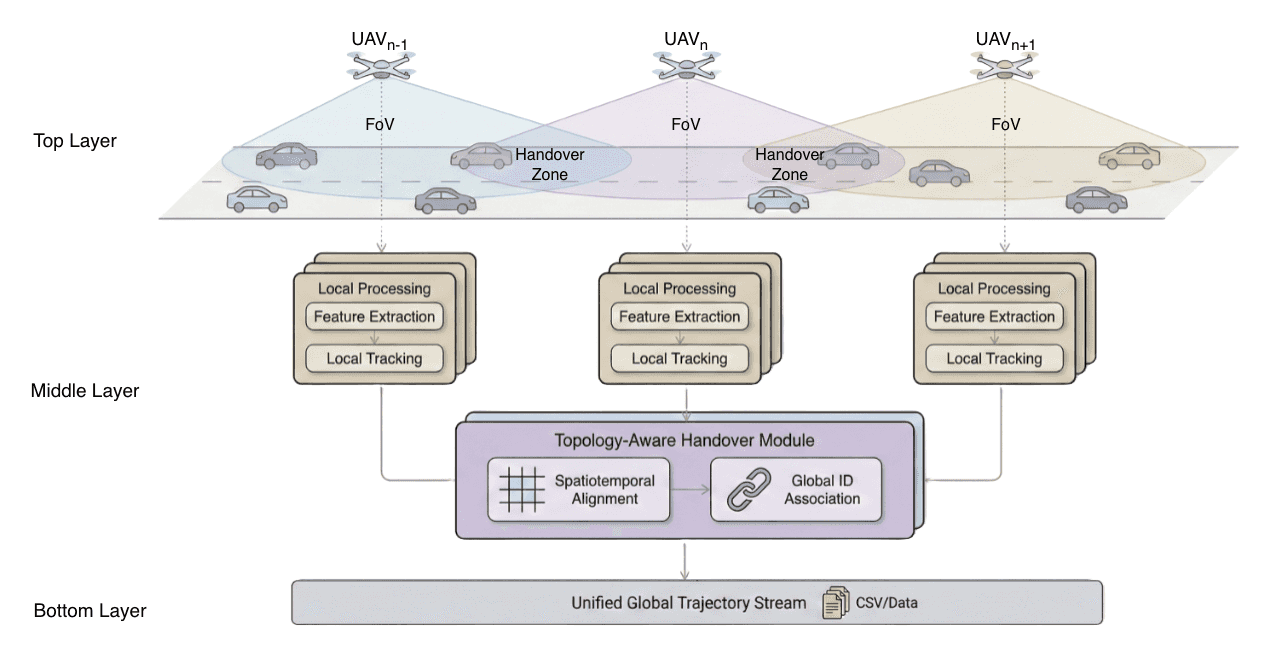
The integration of Unmanned Aerial Vehicles (UAVs) into Intelligent Transportation Systems (ITS) offers synoptic visibility for traffic monitoring, yet scalable deployment is hindered by trajectory fragmentation, where vehicle identity persistence is lost across multi-UAV Fields of View (FOV). While state-of-the-art frameworks excel in optimizing local trajectory extraction and stability for single-drone imagery, they often function as isolated data silos that generate disjointed trajectories, thereby precluding network-level analysis such as Origin-Destination estimation. This paper presents a real-time Multi-Camera Multi-Vehicle Tracking (MCMT) system designed to handle global identity persistence. Addressing the visual ambiguity and computational cost of appearance-based Re-Identification (Re-ID) in nadir views, we introduce a lightweight Topology-Based Spatiotemporal Handover mechanism. We implement a high-throughput parallel pipeline leveraging YOLO11 and ByteTrack to process concurrent 4K streams. Our core contribution is a deterministic queue-based matching algorithm that utilizes geometric overlaps and virtual lane discretization to predictively manage identity handover via FIFO queues. Experimental results on complex urban environments, including intersections and merging traffic, demonstrate a Handover Success Rate (HOSR) of 99.8% in continuous traffic flows, significantly outperforming Re-ID baselines (74.1%) while validating edge deployment feasibility. The source code is available at https://github.com/JYe9/multi-camera-multi-vehicle-tracking-system.
BibTeX
Comments